
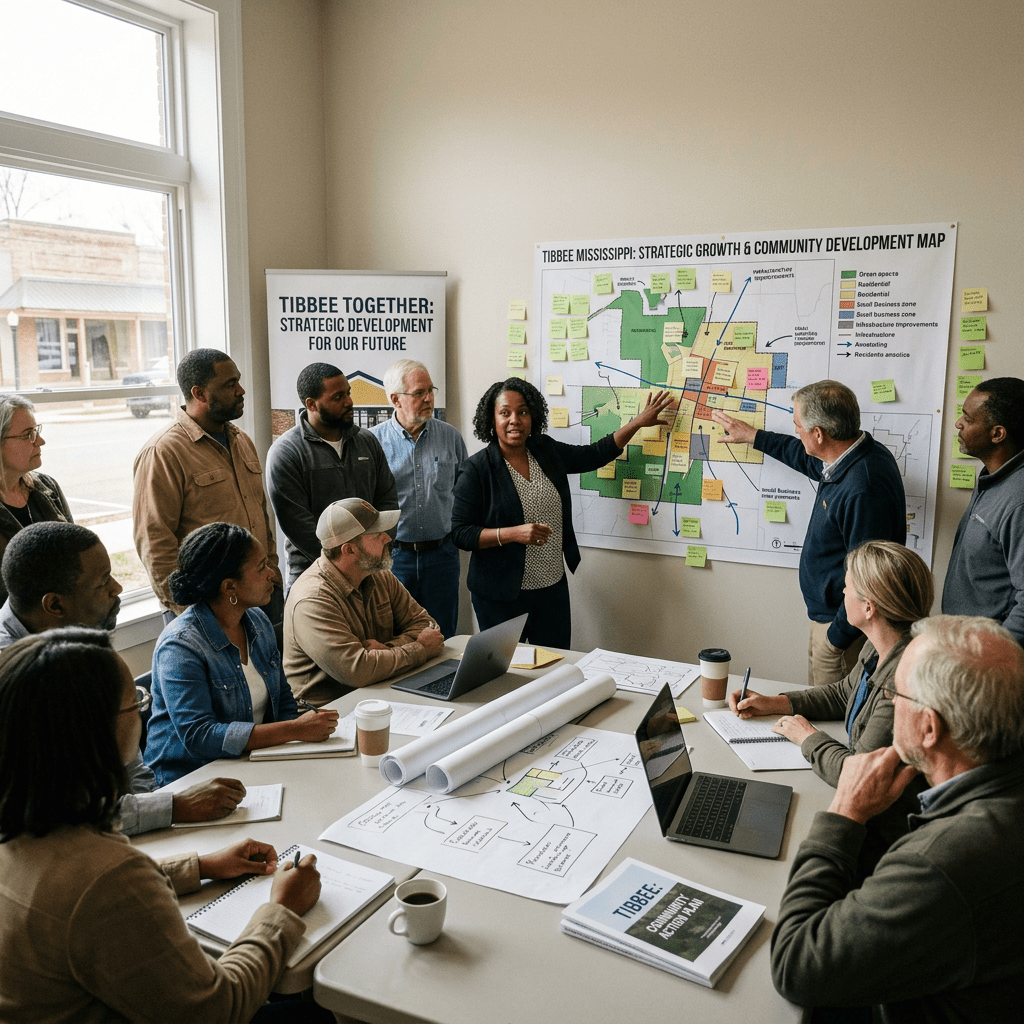
Core Insights from the Brookings Commission Analysis
- The Disinvestment vs. Innovation Paradox The commission noted that deep, long-standing historical disinvestment in the region coexists with exceptional localized innovation. For Tibbee, this means the lack of municipal funding should not be viewed as a dead end, but as a justification for implementing independent, self-sustaining operations. This is directly supported by the TDC’s 2026 user-fee model for building rentals and training classes.
- The “Mississippi Miracle/Marathon” Model Panelists discussed the “Mississippi Marathon”—the reality that sustainable rural transformation requires structural intentionality and prolonged tracking over years, not months. The school tracking models referenced, where reading metrics are displayed publicly like athletic records, underscore the power of radical transparency.
- Church-as-Hub Trust Capital A critical operational takeaway from the commission’s fieldwork involved a school system struggling to register students. Registration targets were missed entirely until the operation shifted physically into local churches. Because the local faith community possessed absolute baseline trust, participation rates spiked immediately.
- Navigating Disparities in Resource Routing Bill Bynum (CEO of Hope Credit Union) highlighted an ongoing rural barrier: federal and state funds route unevenly based on political proximity. Large entities with structural boards connected directly to legislative offices capture outsized funding, while local institutions face low funding ceilings. Bynum’s core recommendation to national policymakers is to establish mechanisms that put capital directly into the hands of grassroots community groups.
Strategic Action Plan & Recommendations for Tibbee
To maximize the impact of these insights, the Tibbee Development Club should transition its findings into three interconnected narrative strategies.
Strategy 1: Capitalization & Bypassing Gatekeepers
The club must avoid relying exclusively on state-managed federal pipelines where political friction can stall small-scale rural grants. The board should prioritize direct-to-nonprofit foundation grants—such as the 4-County Foundation application—and build relationships with Community Development Financial Institutions (CDFIs). Given Bill Bynum’s leadership at Hope Credit Union and Hope Enterprise Corporation, the club should actively pitch its 2026 Capital Reinvestment Plan, including the Historical Marker Fund and the acquisition of the Jones Chapel property, to regional CDFIs looking for highly compliant, asset-backed grassroots initiatives.
Strategy 2: Institutionalizing the Marathon
The club must transition the Key Performance Indicators and Measurement (KPIM) framework from an internal planning sheet into a public-facing community report. By utilizing an automated pipeline that connects basic spreadsheets directly to accessible visual data dashboards, the board can track target reductions in the cost per beneficiary alongside jumps in rental revenue. This models the exact data-driven intentionality praised by national think tanks and builds ironclad trust with outside funders who require verification of localized outcomes.
Strategy 3: Trust-Hub Mobilization
The video panel highlighted that transit limitations and geographic distance remain overwhelming barriers to rural health care delivery. By constructing a private telemedicine booth inside the Tibbee Community Center and outfitting it with acoustic privacy screens, professional blood pressure monitors, and pulse oximeters, the club creates a vital, localized alternative. To ensure successful implementation, the 8-week health literacy courses and telemedicine workshops should be co-marketed directly through local faith networks, utilizing the established pulpit-to-pew trust infrastructure to overcome technological hesitation among seniors.
AI Disclaimer
Notice: This document was compiled, structured, and analyzed by an artificial intelligence assistant based on source materials provided by the user and transcribed public proceedings from the Brookings Institution. The recommendations contained herein are strategic interpretations intended solely for educational, planning, and organizational development purposes. They do not constitute formal legal, financial, or certified architectural counsel. The Tibbee Development Club Board of Directors should independently vet all procurement and legal frameworks against municipal, state, and federal codes before project execution.
 Tibbee Enterprise Development LLC
Leave a comment